

10 Signs Your Partner Makes You Feel Emotionally Safe
10 Signs Your Partner Makes You Feel Emotionally Safe emotional safety in a relationship 10 Signs Your Partner Makes You Feel Emotionally Safe Have you ever had one of those…

10 Signs Your Partner Makes You Feel Emotionally Safe
10 Signs Your Partner Makes You Feel Emotionally Safe Have you ever had one of those days when everything feels like a little too much? You come home tired, put your bag down, and tell your partner, “I had a really bad day.” You’re not looking for a solution or a long speech. You just want someone to look at you and say, “Come here. Tell me what happened.”
And somehow, that little moment tells you a lot about a relationship. Feeling loved isn’t always about flowers, expensive dates, or saying “I love you” every morning. Sometimes it’s much quieter. It’s knowing you can be honest without being laughed at, and knowing you can say, “That hurt me,” without worrying that the conversation will turn into a fight.
That’s what emotional safety in a relationship can feel like. You don’t have to be happy all the time, and you don’t even have to agree with each other all the time. You simply know that when life gets messy, you don’t have to hide the messy parts of yourself.
And honestly, isn’t that one of the things we all want from the person we love? Someone we can finally relax around.
What Does Emotional Safety Mean in a Relationship?
Emotional safety sounds like a big psychological term, but the feeling itself is actually quite simple. It means you feel safe enough to be honest with your partner. You can say, “I’m upset,” admit that you’re scared, or tell them something embarrassing without immediately worrying about rejection.
Researchers often describe this through perceived partner responsiveness—the feeling that your partner understands you, validates what you’re experiencing, and cares about your well-being. Research has linked this kind of responsiveness with intimacy and people’s willingness to share their emotions.
Think about it this way. When you tell someone something personal, you’re taking a tiny emotional risk. If they respond with care, you may feel closer to them. If they laugh, dismiss you, or use your vulnerability against you, you may slowly stop opening up.
That’s why the little moments matter so much.
10 Signs Your Partner Makes You Feel Emotionally Safe
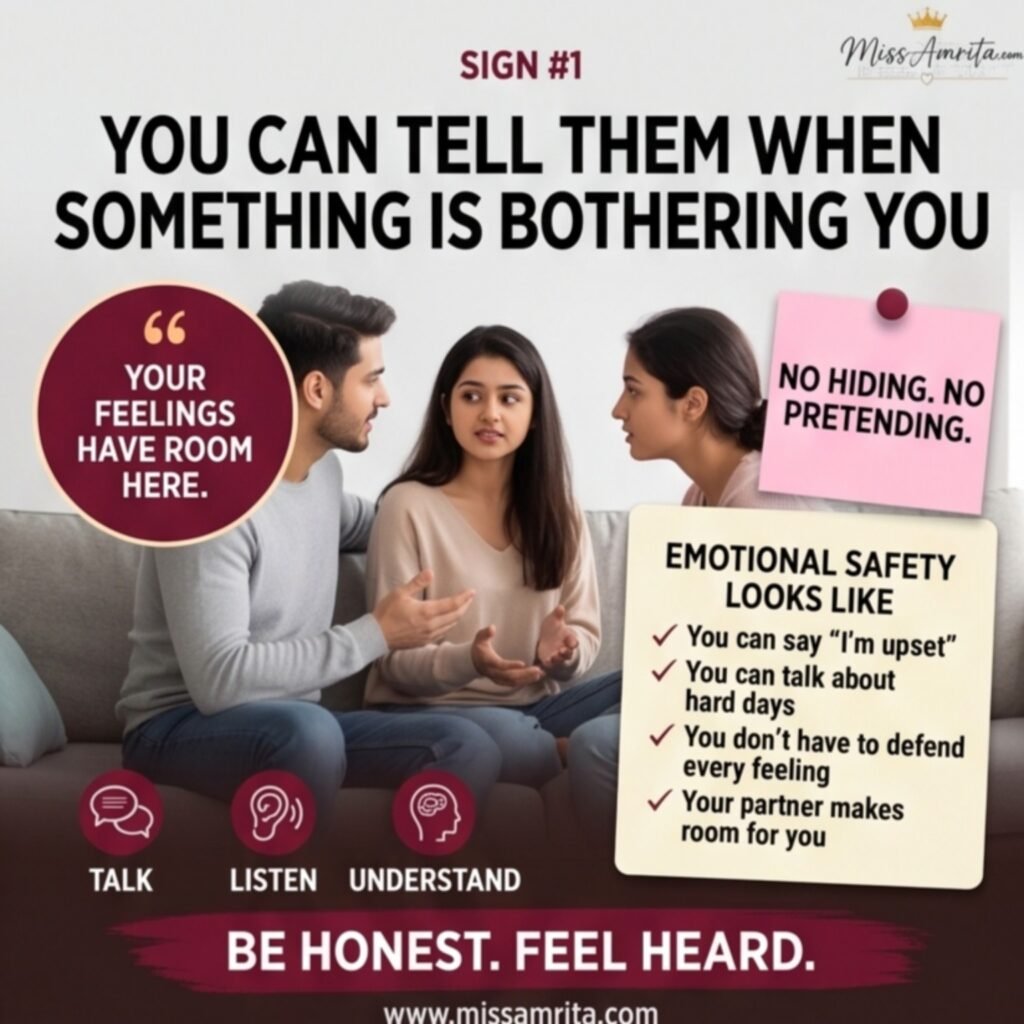
1. You Can Tell Them When Something Is Bothering You
You had a rough day. Maybe your boss said something that hurt, your friend disappointed you, or you’re simply feeling low and don’t even know why. You come home and say, “I’m not feeling great today,” and instead of immediately telling you that you’re overthinking, your partner asks, “What happened?”
That’s a small difference, but it can feel huge. You don’t feel like you have to defend your emotions before you’re allowed to have them. You can simply talk, knowing that there’s room for your feelings in the relationship.
People are more likely to express emotions when they believe their partner will respond in a caring and understanding way. Research has found that perceived partner responsiveness can encourage people to share their feelings, including during stressful situations.
Your partner doesn’t have to agree with every feeling you have. They simply need to make room for you to have those feelings.
2. They Actually Listen When You Talk
There’s listening, and then there’s really listening. You know the difference. You’re telling your partner about something that happened at work, and they’re looking at their phone, giving you a half-hearted “Hmm,” while clearly waiting for you to finish.
Now imagine they put the phone down, look at you, and ask, “What happened next?” Suddenly, the conversation feels different. You feel like the person in front of you actually cares about what’s happening inside your world.
Feeling heard is a big part of emotional connection. Research on partner responsiveness describes understanding, validation, and caring as important parts of how people experience responsiveness from a romantic partner.
Your partner doesn’t need to remember every tiny detail of every story. But you should generally feel like your words matter when you’re talking to them.
3. You Don’t Feel Afraid of Making a Mistake
Let’s be honest. We all mess up. You forget something, misunderstand a message, accidentally say the wrong thing, or make a decision that doesn’t work out. In an emotionally safe relationship, making a mistake doesn’t feel like the end of the world.
You can say, “I messed up. I’m sorry,” and then focus on fixing it. You don’t spend the next six hours worrying about whether your partner will bring up that mistake again, and you don’t feel like you have to hide every little mistake just to avoid their reaction.
That’s important because when you’re constantly afraid of getting something wrong, you eventually stop being yourself. A relationship should give you room to be human.

4. Your “No” Is Respected
Here’s a simple question: Can you say no?
Maybe your partner wants to go out, but you’re exhausted. You say, “Not tonight. I really need some rest.” Do you feel comfortable saying that, or do you immediately start worrying about how they’ll react?
A healthy relationship leaves room for two separate people to have their own needs. Your partner can be disappointed sometimes, and that’s normal. But disappointment is different from punishment.
When your reasonable boundaries are respected, you can breathe a little easier inside the relationship. You know that saying no to one thing doesn’t mean you’re saying no to the person you love.
5. You Can Disagree Without Feeling Like the Relationship Is in Danger
You like one thing. Your partner likes another. You see a situation differently. It happens, because two people don’t have to think exactly alike to love each other.
The real question is what happens when you disagree. Can you say, “I don’t see it that way,” without being insulted? Can your partner have a different opinion without turning the conversation into a personal attack?
You don’t have to win every argument. Sometimes you simply need to know that disagreement doesn’t mean the love disappears.
That’s one of the quiet signs of emotional safety in a relationship.
6. Their Words and Actions Usually Match
This one is easy to overlook. Your partner says, “You can always count on me,” and when you actually need them, they show up. They say they’ll call, and they call. They say they’ll work on something, and over time you actually see an effort.
Of course, nobody gets this right every single time. People get busy, forget things, and have bad days. But over time, there should be some connection between what your partner says and what they actually do.
That consistency helps trust grow. Research on relationship safety suggests that responsiveness and reliable signals of care can influence whether people feel secure enough to trust a romantic partner.
You don’t need promises every day. Sometimes you just need a pattern you can believe.
7. They Care About the Things That Matter to You
Maybe your partner doesn’t understand why you’re so excited about your new hobby. That’s okay. They don’t have to love everything you love.
But when something matters to you, they show some interest. You have an interview coming up, and they remember. You had a difficult conversation with your sister, and they ask how it went. You finally finish something you’ve been working toward for months, and they smile and say, “I’m proud of you.”
Those moments may look small from the outside, but they tell you something important: “Your life matters to me.”
They don’t need to become an expert in everything you care about. They just need to care because it matters to you.

8. You Can Be Completely Yourself Around Them
Think about the version of yourself you show the world. Now think about the version you show when you’re completely comfortable. Maybe you sing badly while cooking, cry during emotional movies, spend Saturday morning in old pajamas, or have strange little habits that nobody else understands.
Can you be that person around your partner?
Or are you constantly trying to look perfect?
A relationship becomes much easier when you don’t feel like you’re performing for love. You don’t have to carefully plan every word or pretend you’re always happy. You can simply exist and feel accepted.
That freedom to be yourself can be one of the most comforting parts of a relationship.
9. They Don’t Try to Fix Every Feeling
Sometimes you don’t need advice. You just need someone beside you.
Imagine you’re upset and your partner immediately says, “Okay, here’s what you should do.” Maybe they’re trying to help, but sometimes you really want to say, “I know you mean well. I just need you to listen for a minute.”
An emotionally safe partner can learn that difference. They might ask, “Do you want advice, or do you just want me to listen?”
That question can completely change a conversation. Research on responsiveness highlights listening and communicating understanding, validation, and care as important parts of responsive partner behavior.
Sometimes the best support isn’t a solution. It’s simply being there.
10. You Trust Them With the Soft Parts of You
This might be the biggest sign.
You can tell them about the thing you’re insecure about. You can admit you’re scared. You can say, “I’m worried I’m not good enough.” You can share something you’ve never told anyone else.
And afterward, you don’t regret opening your mouth.
You don’t lie awake wondering whether they’ll use that information against you during the next argument. Instead, you feel a little lighter because someone knows the real you and didn’t turn away.
Research has long connected self-disclosure, partner responsiveness, and intimacy in close relationships. Opening up can help people feel closer when the other person responds with understanding and care.
You don’t need to tell your partner everything at once. Trust usually grows slowly, one honest conversation at a time.

Emotional Safety Doesn’t Mean a Perfect Relationship
Here’s something worth remembering: an emotionally safe relationship isn’t a relationship where you never argue. You will have bad days. You may misunderstand each other, get annoyed, or say something you wish you could take back.
What matters is what happens next.
Do you come back and talk? Can someone say, “I was wrong”? Can you say, “That really hurt me”? Can you both listen and try to do better the next time?
A relationship doesn’t become safe because nothing ever goes wrong. It becomes safer when both people can handle difficult moments with care.
What Emotional Safety Is Not
Sometimes people think emotional safety means their partner should always agree with them. Not really. Your partner can disagree with you and still respect you. They can have a different opinion, challenge an idea, or tell you that they think you’re making a mistake.
The important part is how they treat you while doing it.
Emotional Safety
Lack of Emotional Safety
You can express your feelings
You hide what you feel
“No” can be respected
You feel pressured to agree
Mistakes can be discussed
Mistakes are repeatedly used against you
Disagreements stay respectful
Arguments become personal attacks
Vulnerability is treated carefully
Private feelings become ammunition
Both people can apologize
One person is always blamed
You can be yourself
You constantly worry about being judged
If you’re regularly afraid of your partner, being threatened, controlled, humiliated, or physically harmed, that’s not simply a communication problem. Your safety comes first.
How to Build More Emotional Safety Together
Maybe you’re reading this and thinking, “My relationship is good, but we could definitely be better at this.” That’s completely okay. You don’t need to rebuild your entire relationship overnight.
Start with one small change.
Ask Before Giving Advice
Try saying, “Do you want me to listen, or do you want help finding a solution?”
It takes only a few seconds, but it shows that you care about what the other person actually needs instead of automatically deciding what they should do.
Be Specific About Your Feelings
Instead of saying, “You never care about me,” try, “I’ve been feeling a little disconnected lately. Can we spend some time together tonight?”
The second sentence gives your partner something they can actually understand and respond to. It also keeps the conversation focused on what you’re feeling rather than attacking their character.
Don’t Punish Honesty
If your partner finally tells you something difficult, try not to become defensive immediately. You can say, “I’m glad you told me.” You can talk about the problem afterward, but first let them know that honesty has a place in your relationship.
Notice the Little Things
Did they remember something important? Did they check on you? Did they listen when you needed them? Tell them you noticed.
Emotional safety isn’t created by one huge romantic gesture. It’s usually built through hundreds of small moments that quietly tell both people, “We’re okay. We’re on the same team.”
A Simple Relationship Check-In
Take a few minutes and answer these questions honestly. You don’t need to show your answers to anyone. This is simply a chance to notice how you actually feel in your relationship.
Question
Think About
Can I tell my partner when I’m hurt?
Do I feel heard?
Can I say no?
Are my boundaries respected?
Can I make mistakes?
Am I afraid of their reaction?
Can I disagree?
Can we disagree without attacking each other?
Can I share good news?
Do they genuinely care?
Can I be vulnerable?
Do I trust them with private feelings?
Can I be myself?
Do I feel like I’m performing?
Do their words match their actions?
Can I generally rely on them?
Can we repair after arguments?
Do we eventually find our way back to each other?
Do I feel emotionally calm around them?
Or am I constantly walking on eggshells?
Don’t worry if every answer isn’t perfect. Nobody gets every relationship skill right. Instead, look at the overall pattern, because that’s where the real answer usually lives.
A Real-Life Story
Maya had been with Daniel for almost three years. From the outside, they looked happy. They went out for dinner, posted pictures together, and rarely argued in public. But Maya had a secret: she didn’t like talking about her problems with Daniel because she was always afraid that saying how she felt might start another argument.
One evening, she finally said, “Can I tell you something without you getting angry?” Daniel looked at her and said, “Of course.” Maya took a breath. “Sometimes I don’t tell you when I’m upset because I’m scared you’ll think I’m being difficult.”
Daniel was quiet for a moment. Then he said something she didn’t expect: “I didn’t know you felt that way. What can I do differently?”
That conversation didn’t magically fix everything. They still had misunderstandings, and they still had difficult days. But something changed. Maya started speaking more honestly, and Daniel started listening more carefully.
Months later, Maya laughed and said, “You know what’s funny? I don’t feel like I have to rehearse conversations with you anymore.” Daniel smiled. “That’s probably a good thing.” She laughed. “It really is.”
Sometimes emotional safety doesn’t arrive with a big romantic moment. Sometimes it grows quietly—one honest conversation, one patient response, one promise kept, and then another.
Final Thoughts
Maybe the safest relationships aren’t the ones that look perfect from the outside. Maybe they’re the ones where you can finally take a deep breath and be yourself without wondering whether you’re going to be judged for every little thing.
You can say, “I’m having a bad day.” You can admit, “I was wrong.” You can say, “That hurt me.” You can ask for space. You can share good news. You can cry. You can laugh at something completely silly.
And through all of it, you don’t feel like you’re going to lose the relationship simply because you showed your real self.
That’s the beauty of emotional safety in a relationship. It’s not about never getting hurt. It’s about knowing that the person you love will generally treat your heart with care.
Research continues to highlight partner responsiveness—feeling understood, validated, and cared for—as an important part of intimacy and relationship well-being.
So ask yourself tonight:
“Can I truly be myself with the person I love?”
If your answer is yes, don’t take that feeling for granted. And if your answer is no, don’t ignore it either. Sometimes that little uncomfortable feeling is worth listening to.
Frequently Asked Questions
What is emotional safety in a relationship?
Emotional safety means feeling comfortable enough to share your thoughts, feelings, needs, and vulnerabilities without constantly fearing rejection, humiliation, punishment, or judgment.
How do I know if my partner makes me feel emotionally safe?
Look at how you feel when you’re honest with them. If you can talk about difficult feelings, make mistakes, set reasonable boundaries, disagree respectfully, and be yourself without constant fear, those are positive signs.
Can emotional safety be built over time?
Yes. It usually develops through repeated experiences of listening, reliability, respect, honesty, and caring responses. It isn’t created in one conversation.
Does emotional safety mean couples never argue?
No. Couples can disagree and still have a healthy relationship. Emotional safety is more about being able to handle disagreements without humiliation, intimidation, threats, or deliberately hurtful behavior.
Why is feeling heard so important in a relationship?
When people believe their partner understands, validates, and cares about them, they may feel more comfortable sharing their emotions. Research on perceived partner responsiveness connects this process with intimacy and emotional expression.
What if I don’t feel emotionally safe with my partner?
First, notice what is making you uncomfortable. If you feel safe doing so, talk about it during a calm moment and be specific about what you need. But if you’re dealing with threats, coercion, abuse, or fear, don’t treat it as a simple communication problem. Your safety comes first.
Your Turn ❤️
Think about your partner for a moment.
What’s one little thing they do that makes you feel safe?
Maybe they listen when you’re upset. Maybe they never make fun of your feelings. Maybe they remember the little things you tell them. Or maybe they simply give you a hug when you don’t know what to say.
Whatever it is, don’t underestimate it.
Sometimes love doesn’t sound like a grand promise. Sometimes it sounds like:
“I’m here. Tell me what happened.”
And sometimes, that’s exactly what a heart needs.
Share your answer in the comments. Your little story might remind someone else that emotional safety isn’t about having a perfect relationship—it’s about having a relationship where you feel safe enough to be yourself. ❤️
Read Next
12 Signs Someone Truly Respects You in a Relationship
If you’re trying to understand whether the person you love truly respects your feelings, boundaries, and individuality, that’s a natural next step after learning about emotional safety.

Miss Amrita
I'm here to help you heal, grow and create a life you love. You are not alone on this journey. ♥
View All Posts →
0 Comments
Leave a Comment ♥
Have a thought, tip or story to share? We'd love to hear it.